
“It really is a little song that’s more than just a song. It’s about a philosophy and attitude and a feeling.”
~ Dolly Parton explaining “Coat of Many Colors”
When it comes to glitzy and gaudy, nobody could hold a candle to the late Dolly Parton. An unmatched singer and songwriter – and a shrewd businesswoman besides – she was famous for her unabashedly glittery look. Dolly liked to be noticed. Her wardrobe’s sparkle matched her bigger-than-life personality.
It was not just the clothes that shone. Dolly resided in the realm of gold records, with 52 Gold, Platinum, and Multi-Platinum certifications over a career spanning decades. Even her final LP, released in 2023 at age 77, went Gold. Dolly was a multi-generational star.
For a woman known for flash, Dolly was deeply grounded in substance shaped by her upbringing. She wrote about that life in “Coat of Many Colors,” the story of a coat her mother sewed from rags in the Tennessee mountains. It was rich in the love and labor that went into it, not in its looks. Dolly’s coat didn’t glimmer, but everything that went into it held real value and made it special for her.
MPMG holds a similar affinity for assets that others overlook or, in some cases, scorn. Ironically, one place we find that in today’s market is something that, like the Dolly we came to know and love, has a shimmer of its own. We have deliberately made gold a major theme in the MPMG All-Cap Value Composite portfolio. It has not represented this large a share of the portfolio in 20 years.
© Robert Weber / The New Yorker Collection/The Cartoon Bank
Gold’s Multi-Generational Appeal
The precious metal gold, in its own way, is also a multi-generational star. While fusion in a single dead star can create iron, forging gold requires the remnants of multiple generations of dead stars – neutron stars. Gold is a finite metal. Making more gold is, for all practical purposes, impossible. Scarcity enhances gold’s appeal, as well as its utilitarianism. The following key traits address a range of commerce and trade challenges:
- Durability- Gold does not rust or decay. Value can sit for centuries.
- Scarcity, slow supply- You can’t print it. Any new supply is limited by geology and mining costs. Annual mine output is a small fraction of the existing stock. This is the opposite of the ease of printing paper money at will.
- Portability- A great deal of value fits in a small space, so it can move with trade.
- Divisibility and fungibility- Melt, coin, recombine; an ounce is an ounce.
- Malleability- Gold can be hammered or struck into a new shape without cracking, which is what made coinage and fine work possible with simple tools.
- Universality and recognizability- Gold is hard to fake. Almost every civilization treats it as precious.
- Incorruptibility- Unlike iron or copper, gold does not easily combine with other elements. Symbolically, that represents purity and permanence; economically, it is a store of value that does not quietly disappear.
- Beauty- Jewelry provides residual demand for gold if it is no longer considered a form of payment.
As commerce and trade accelerated, the need for a currency of exchange, one that was lighter, more easily divisible into smaller amounts, and backed by gold, gave it value. From the 19th century through 1933, the dollar was defined by its weight in gold. In principle, at least, citizens could redeem notes for gold.
Much of Europe moved off the gold standard during World War I, and by 1933, in the depths of the Great Depression, the U.S. followed suit. The federal government abandoned the gold standard to stem the combined run on banks and gold. Officially, the dollar was still defined in gold, but only for international settlements.
In 1971, President Richard Nixon closed the “gold window” for good, limiting foreign countries’ ability to exchange dollars for gold. Dollars could be exchanged only for other dollars or other fiat currencies, which are government-issued money not backed by gold or silver.
The decline of fiscal discipline
With the gold window closed, the built-in check on the money supply went with it. When we warned of that break in a second-quarter 2006 letter, “Deficits without Tears,” and made the case for a meaningful gold position, the money supply had already risen from $633 billion in 1971 to about $7 trillion, more than tenfold. It has since more than tripled, to about $23 trillion, roughly 36 times the 1971 level. Most of that growth tracks the expansion of federal debt.
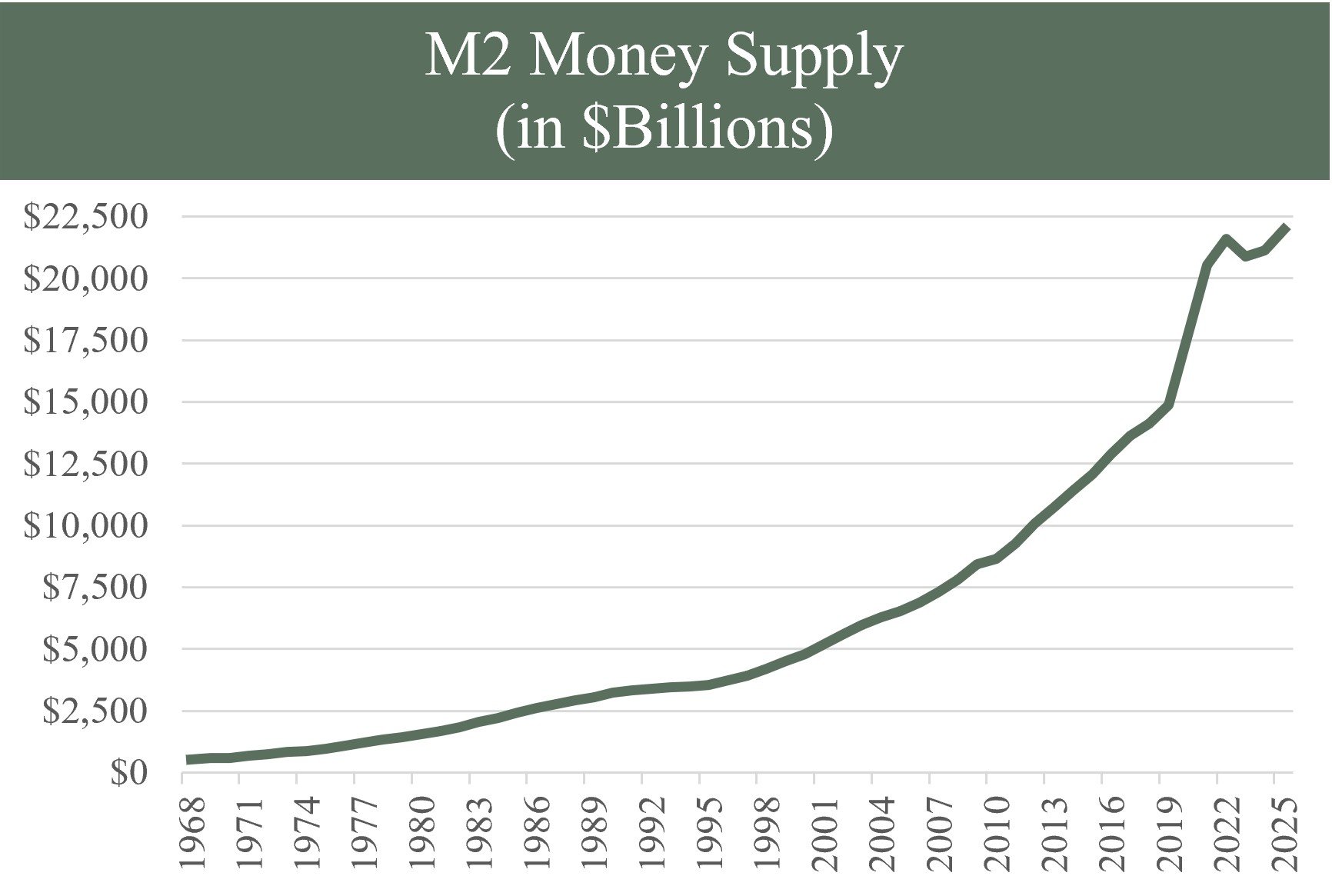
Source: Board of Governors of the Federal Reserve System (US) via FRED
We noted in 2006 that the fear with fiat money is simple: if more currency is created than the economy can absorb, purchasing power falls. Its value declines as more money is circulated.
The consequence is a rapid rise in living costs, or inflation, often described as too much money chasing too few goods. But the loss of purchasing power since the U.S. closed the gold window is astounding. Purchasing power (as measured by CPI) has fallen by 90% since 1970, and by nearly 40% since our 2006 newsletter. This represents significant wealth destruction for consumers and is one of investors’ most significant long-term challenges.
Accelerating deterioration of fiscal prudence
The nation’s fiscal position continues to deteriorate. Federal debt now exceeds $40 trillion, roughly 100 times the level at the end of 1970, the last full year before the United States closed the gold window. Debt-to-GDP, the share of annual output that debt represents, is now above 100% and on a path to rise further without a course correction in Washington.
The ability to print fiat money plays right into the hands of politicians who, in our view, use the Federal treasury to win favor with voters and consolidate their power. This is not about partisanship but about incumbency. The formula is simple – borrow more money and win elections with impunity.
Deterioration in federal borrowing has been a primary driver of the recent spike in interest rates. The yield on the benchmark 10-year Treasury, which touched 0.55% as recently as 2020, now stands above 5%. Higher yields make new debt more expensive, whether the Treasury is refinancing what is coming due or borrowing to cover spending. With rates up and the stock of debt still growing, net interest on the federal debt now exceeds spending on national defense, the largest discretionary item in the budget.
The debt problem isn’t limited to the U.S. Most of the large, developed economies have government debt-to-GDP ratios above 100%.1 The U.S. and other industrialized nations face unfavorable demographic trends, namely an aging population, that exacerbate spending pressures and set the stage for stagnant revenue growth, further weakening their borrowing profile.
Our current state of borrowing is unsustainable. While no tears have yet been shed over global debt concerns, we subscribe to the old bromide from economist Herb Stein, which says, “If something can’t go on forever, it will stop.”
Gold vs S&P 500 • monthly • nominal • August 1971=100 • log scale
indexed from the month Nixon closed the gold window- 55 years without a gold standard:
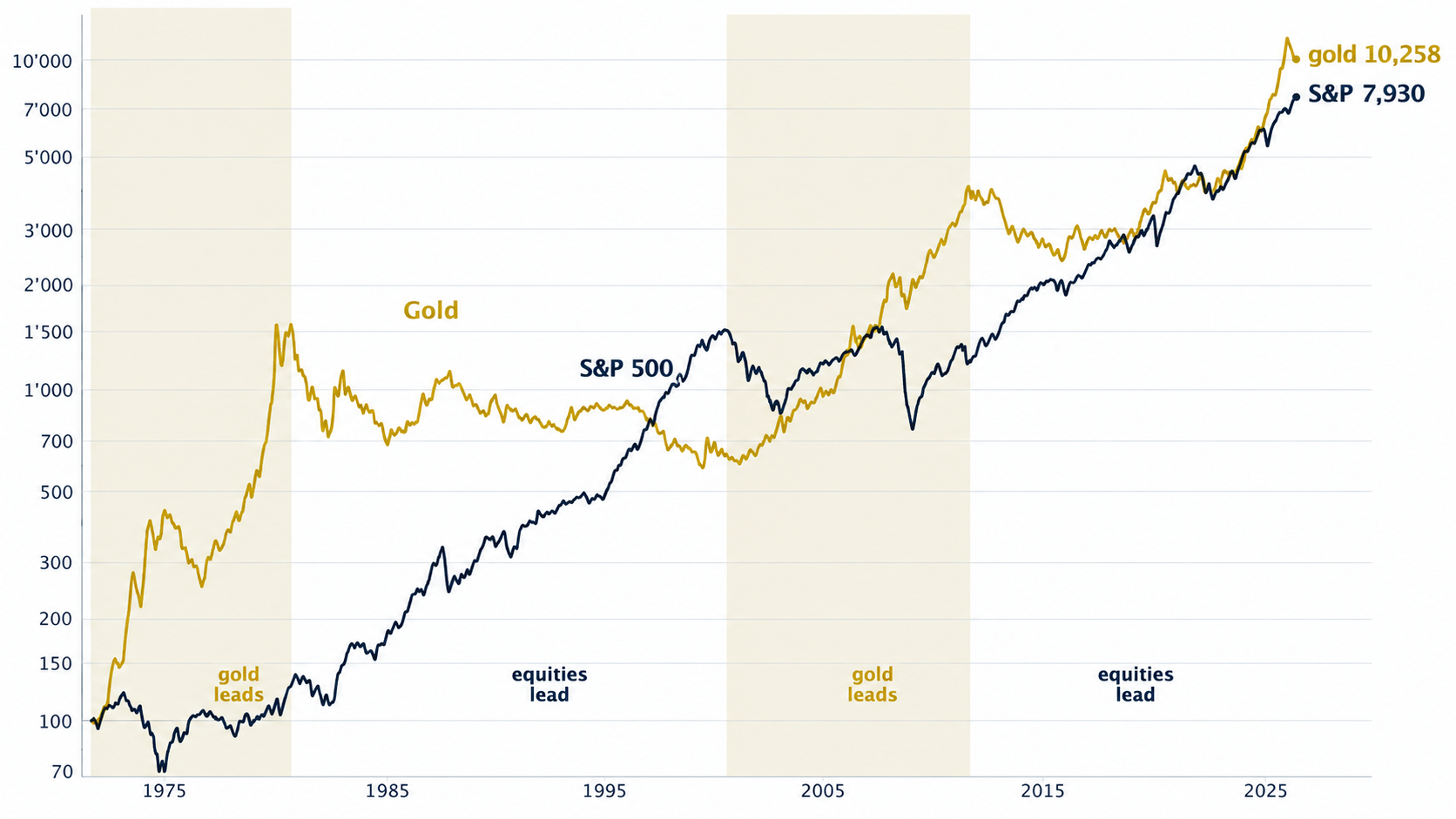
Source: arvy AG, www.arvy.ch
Gold shines again
Gold looks more useful with the money supply rising, purchasing power falling, and government debt still climbing. That is why MPMG raised its gold exposure to the highest level since 2006. When we first made that case, twenty years ago, gold was about $600 an ounce. It is now about $4,170.
Since 1971, dollar-priced gold has compounded at roughly 8% to 9% a year, in line with equities over that span and ahead of bonds. Its added appeal is that it has tended to hold up when stocks and bonds are under stress. Across seven stress windows since 2007, including the financial crisis, the 2018 trade-war selloff, and COVID, gold returned 26%, against a 4% loss for the S&P 500 and a 5% gain for U.S. Treasuries.
© Evan Lian / The New Yorker Collection/The Cartoon Bank
Central banks have been a large part of the bid, treating the metal as a hedge against currency debasement and concentration in the dollar. They bought more than 1,000 tonnes a year from 2022 through 2024, the three largest annual totals on record and more than double the prior decade’s average, and came just shy of that pace in 2025. The motives are the familiar ones: reserve diversification, sanctions risk, geopolitics, and an asset with no issuer.
Owning the producers, not the metal
We do not want a passive holding in gold. We want the businesses that produce it, and we are deliberate about which ones. The MPMG All-Cap Value Composite owns two: Newmont Corporation (NEM, $115.34) and Barrick Mining Corporation (B, $40.67).2 Newmont is the world’s largest gold miner, and the only one in the S&P 500. Barrick is a Canadian gold and copper producer.
These are large producers, and that is the advantage. Much of the procurement cost of an ounce is already in place, so a higher gold price falls largely to profit. They also hold vast reserves, gold that has not yet been mined. That gold is an asset whether or not a single ounce comes out of the ground, and a higher price raises its value. Put the two together and large miners have historically gained closer to 2.5 times the move in the gold price, rather than matching it one for one.
We believe that three things set Newmont and Barrick apart:
- They are virtually unhedged. A hedge sells future production at a fixed price and gives away the upside. An unhedged producer sells at the spot price, so a rise in gold comes through in revenue and cash flow, and the market is free to reprice the ounces still in the ground.
- Those ounces stay on the balance sheet at cost. The shares reprice.
- Their balance sheets are clean. Plenty of competitors borrowed heavily to buy and build mines, and the interest on that debt consumes the margin a higher gold price would otherwise produce. Newmont and Barrick do not carry that same burden.
Their mines sit in comparatively stable jurisdictions, where the risk of shutdown or government interference is lower than it is across much of the industry. A reserve is only as good as the ability to mine it.
A good time to own the coat
Step back from the day-to-day and the larger picture is easier to see. That is how we look for opportunity. One result of that look is gold. Governments have taken on more debt than the old rules were built for, and we have chosen to use that opening by purchasing stock in the companies that produce the metal. Gold is not the whole of it. The same discipline turns up attractive opportunities that have nothing to do with the debt story, in artificial intelligence, quantum computing, industrial production, and healthcare, and in plenty of businesses that will never make a headline.
Bloomberg’s consensus forecast calls for S&P 500 earnings to grow 26.2% this year, which would be the third-highest annual operating-earnings gain in more than two decades. The same forecasts call for 16% growth in 2027 and 15% in 2028, against roughly 9% a year over the last decade. We are in a period of robust profit growth, and a great many of the businesses producing it still sell at prices that do not reflect the opportunity. As active investment managers with a discerning eye towards value, we consider this to be an attractive environment.
In a period of inflation and eroding purchasing power, we believe the best place for capital is in stocks, and not in bonds. Bonds pay a fixed coupon. Inflation takes a piece of that coupon every year, and higher yields have already eroded its value. A stock is a claim on a business that can reprice what it sells.
That only holds for the right stocks. We look for great companies with moats, barriers that make the business hard to copy. A unique business, selling something the world actually needs, has pricing power. It can raise prices by more than the rise in its own costs, and the owner of the shares participates in that. Historically, that is why stocks have been a good hedge against inflation, and why a bond is a poor one. The coupon does not get to answer back.
Dolly Parton called “Coat of Many Colors” one of her most personal songs. She was not singing about something glittery. She was singing about value that did not show on the surface. That is still the right description of the MPMG All Cap Value composite portfolio. Most of the holdings would not win a popularity contest. Look closer, and the substance is there: producers of a metal the world is accumulating, and businesses with the pricing power to outrun the loss of purchasing power that metal is there to offset. A good time to own the coat, not just the rhinestones.
~MPMG
1 Six of the Seven G7 countries have debt-to-GDP above 100%: Japan, Italy, the United States, France, Canada, and the United Kingdom.
2 Prices as of September 30, 2026 close.
Established in 1995, Minneapolis Portfolio Management Group, LLC actively manages separate accounts for individuals, families, trusts, retirement funds, and institutions. Our proven value-oriented investment philosophy has created long-term wealth for our clients.
Visit our website at: www.MPMGLLC.com
Although the information in this document has been carefully prepared and is believed to be accurate as of the date of publication, it has not been independently verified as to its accuracy or completeness. Information and data included in this document are subject to change based on market and other condition. All prices mentioned above are as of the close of business on the last day of the quarter unless otherwise noted. Market returns discussed in this letter are total returns (including reinvestment of dividends) unless otherwise noted.
The information in this document should not be considered a recommendation to purchase any particular security. There is no assurance that any of the securities noted will be in, or remain in, an account portfolio at the time you receive this document. It should not be assumed that any of the holdings discussed were or will prove to be profitable, or that the investment recommendations or decisions we make in the future will be profitable. The past performance of investments made by MPMG does not guarantee the success of MPMG’s future investments. As with any investment, there can be no assurance that MPMG’s investment objective will be achieved or that an investor will not lose a portion or all of its investment.
Companies mentioned in this document were chosen based on MPMG’s view of the products and/or services offered or provided by the companies in light of current economic and market observations and reported trends. For a complete listing of MPMG’s recommendations over the preceding 12 months, please contact MPMG at (612) 334-2000.
Double-click to edit...