
2026 | Q1- Paths to prosperity – from iron nails to AI
“Artificial intelligence will reach human levels by around 2029. Follow that out further to, say, 2045, we will have multiplied the intelligence, the human biological machine intelligence of our civilization a billion-fold.”
~ Ray Kurzweil, computer scientist and author
Artificial intelligence (AI) is today’s defining technology. It has the power to reshape business, daily life, and long-term prosperity. If you wonder whether AI marks a seismic economic shift, history offers a fitting parallel in something as ordinary as the iron nail.
In the late 1700s, a simple iron nail was a luxury item, painstakingly hand-forged by blacksmiths at considerable expense. Yet those nails represented a breakthrough: they enabled stronger, faster construction than wooden pegs alone. The real transformation came with mechanization—first through early “cut nails,” and later with automated wire-nail machines in the late 1800s. Production surged, costs plummeted, and nails became abundant and inexpensive. What had once been a scarce, high-cost craft good turned into a ubiquitous building block of progress. Cheaper, stronger construction didn’t just improve one sector—it sparked cascading waves of innovation and productivity gains across the broader economy, accelerating growth in housing, manufacturing, infrastructure, agriculture, and commerce, and ultimately driving widespread prosperity.
Today, AI follows a strikingly similar path. Like the nail, its productivity gains will not be confined to a single sector. Instead, they will most likely spread broadly across the entire economy. Its usefulness is already evident—accelerating scientific discoveries, streamlining complex systems, and amplifying human creativity. At present, cutting-edge AI capabilities remain scarce and expensive, concentrated in massive data centers and specialized hardware. But just as with nails, this scarcity appears temporary. Rapid advances in algorithms, chip design, and infrastructure are driving costs lower at an accelerating pace. We expect AI and computing power to eventually become widespread, approaching near-zero marginal cost. When that happens, the productivity boom could be profound—replacing outdated labor-intensive processes with new opportunities and ushering in another era of abundance.

© Lynn Hsu / The New Yorker Collection/The Cartoon Bank
The Track Record: From Displacement to Discovery
History is rich with examples of major industrial transformations that initially sparked concern, but ultimately drove remarkable economic growth and widespread prosperity. While observers at the time often worried about job losses and disruption, these fears proved largely unfounded. Workers adapted—through retraining and shifting roles—and entirely new industries and higher-value jobs emerged. The net result was not scarcity, but expanded opportunity, greater productivity, and rising living standards.
Consider these pivotal shifts:
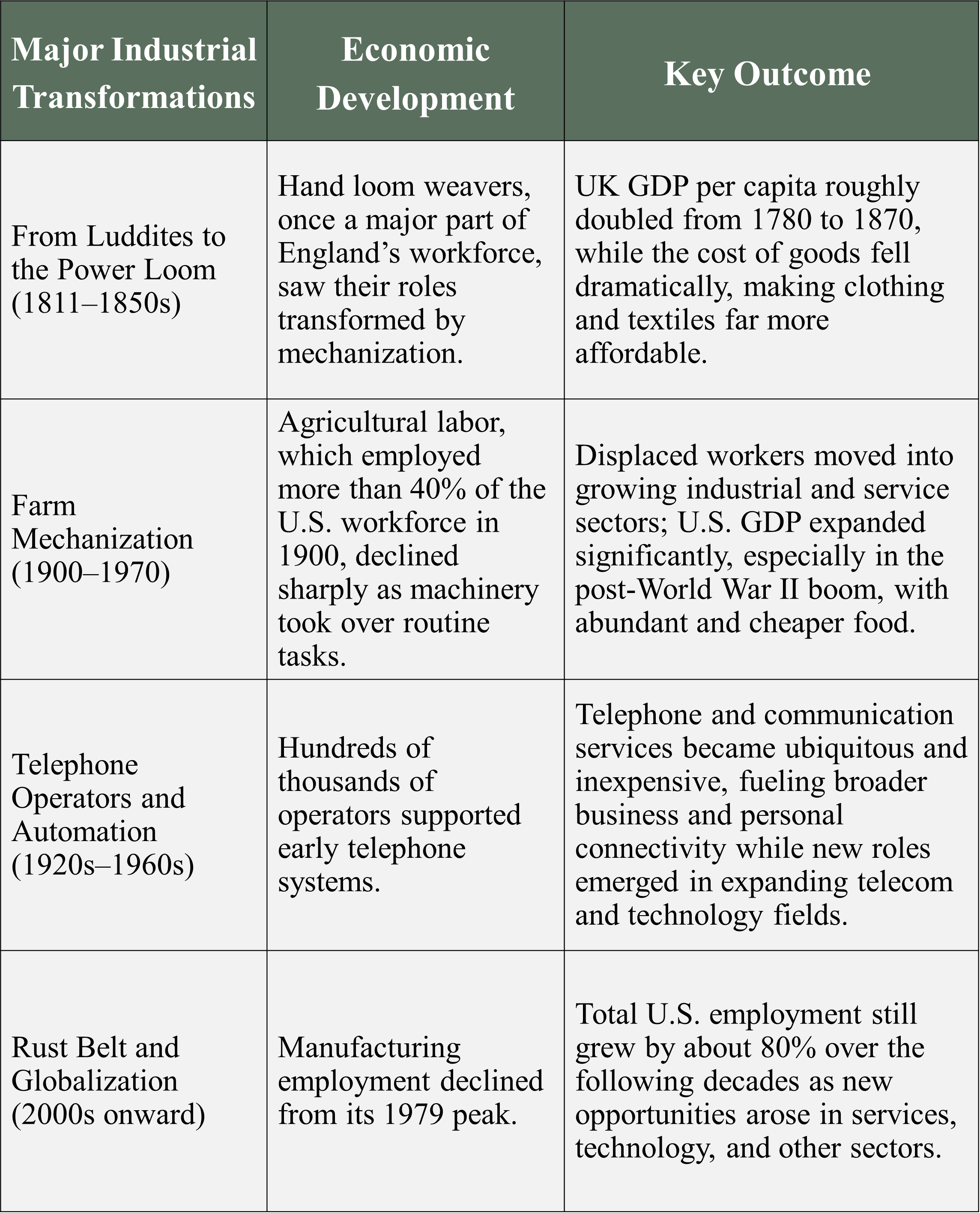
Sources: FD, “Macro | AI’s Impact: What 200 Years of Layoff Panics Tell Us About AI,” Robonomics (Substack), March 16, 2026, and historical economic data.
The key takeaway is clear: each of these transitions generated short-term adjustment challenges for specific industries and occupations, yet the broader economic impact was strongly positive. Innovation redirected human effort toward more creative, productive work and amplified overall value.
AI represents the latest chapter in this long story. What distinguishes it is the accelerated pace of change. While past transformations unfolded over decades, AI’s capabilities are advancing far more rapidly than anticipated even a few years ago. Still, the timeless lesson remains: technological progress, when harnessed thoughtfully, tends to expand the economic pie rather than shrink it.
The Next Frontier
While machines like the power loom automated muscle, AI promises to automate cognition. From an investor’s perspective, a golden opportunity exists to own slices of that advancement. Companies harnessing AI-driven efficiencies offer a stake in the next wave of progress and compounding growth.
The projected macroeconomic impact of AI is impressive. According to International Data Corporation (IDC), business spending on AI solutions and services is expected to generate a cumulative global economic impact of $22.3 trillion through 2030. Even more striking is the multiplier effect: in 2030 alone, every new dollar spent on business-related AI solutions and services is projected to generate $4.90 in broader economic value through indirect and induced effects1.
The most notable difference appears at a more microeconomic level. Consider how various industries can leverage AI:
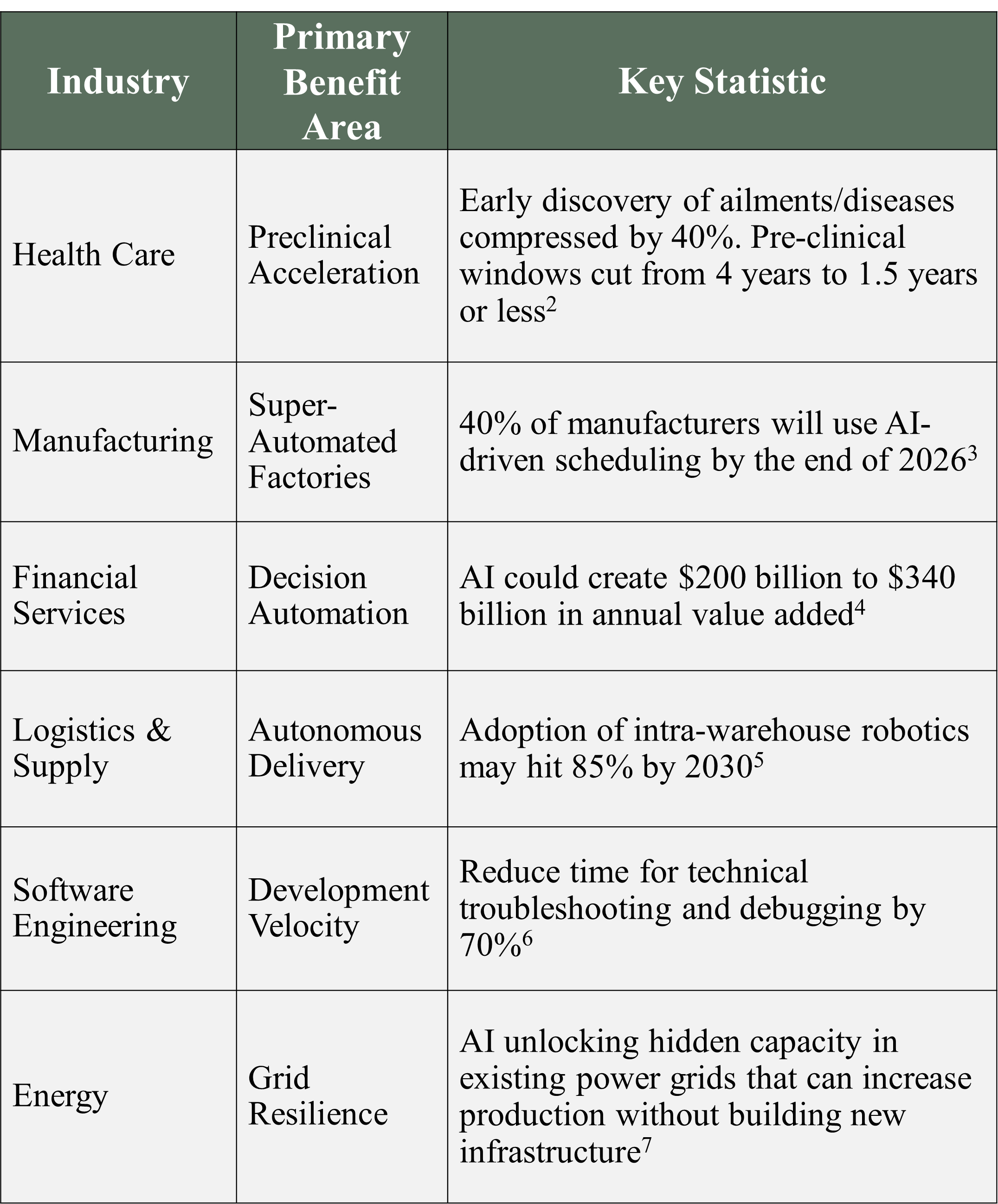
These are “tip of the iceberg” examples that showcase the wide-ranging influence of AI on the larger economy and why investors should be excited about the opportunities ahead.
Navigating Uncertainty: Empathy, Reason, and Opportunity in Geopolitical Turmoil
Few people wish for armed conflict; at MPMG we acknowledge the profound pain, loss of life, and human suffering it causes. Times like these—marked by sudden escalations involving the U.S., Israel, and Iran—can feel profoundly chaotic and unsettling, stirring deep anxiety not only for global stability, but also for personal portfolios.
As investors, however, we must separate emotion from strategy. While headlines dominate and markets swing on developments in the conflict, history reminds us that emotional reactions often lead to costly mistakes. Short-term volatility is real: oil prices have spiked amid supply concerns, inflation risks have risen, and key indices like the S&P 500, Dow and NASDAQ have seen declines of close to 10% or more (though as of this letter’s publishing these indices have recovered somewhat). Yet these unsettled periods have repeatedly created opportunities for disciplined, forward-looking investors who focus on long-term fundamentals rather than short-term fear.
It is notable that periods of market chaos have historically benefited value stocks. Investors rotate toward businesses trading at discounted valuations backed by strong cash flows and solid assets. These provide a margin of safety in uncertainty.
Conversely, uncertainty has typically hurt growth stocks, whose value depends on optimistic future expectations. We saw this after Russia’s 2022 invasion of Ukraine, where the MSCI World Value Index outperformed the Growth Index by about 15%8.
We are witnessing this rotation again—and it may represent an important inflection point. The popular Magnificent 7 stocks9 —high-valuation names many crowded into regardless of price—have struggled both toward the end of 2025 and in Q1 2026. The group declined more than 10% in Q1 (with several members posting significantly steeper losses), even as the broader S&P 500 fell roughly 4.3%. In fact, most major US and international equity markets were negative for the first three months of 2026.
The concentration risk within the S&P 500 index and other market capitalization weighted indices to these Magnificent 7 stocks deserve careful consideration. At their peak last year, the Magnificent 7 accounted for roughly 35-40% of the S&P 500’s total market capitalization. We are not suggesting this is identical to the dot-com era, but history offers a cautionary parallel: after the 2000 market peak, when richly valued technology stocks dominated, it took the S&P 500 close to 13 years to fully recover from its deep losses. Passive index investing that replicates these popular indices assumes quick market rebounds, but when leadership is overly concentrated in overpriced names, recoveries can be long and uneven.
In sharp contrast, MPMG’s patient, long term, and disciplined value strategy is rewarding investors not only by avoiding losses, but also powering higher—with MPMG clients up over 5% in the first quarter*. By building concentrated, yet diversified, portfolios of world-changing companies that we believe to be undervalued today, we have confidence that our approach is exceptionally well positioned now and into the future.
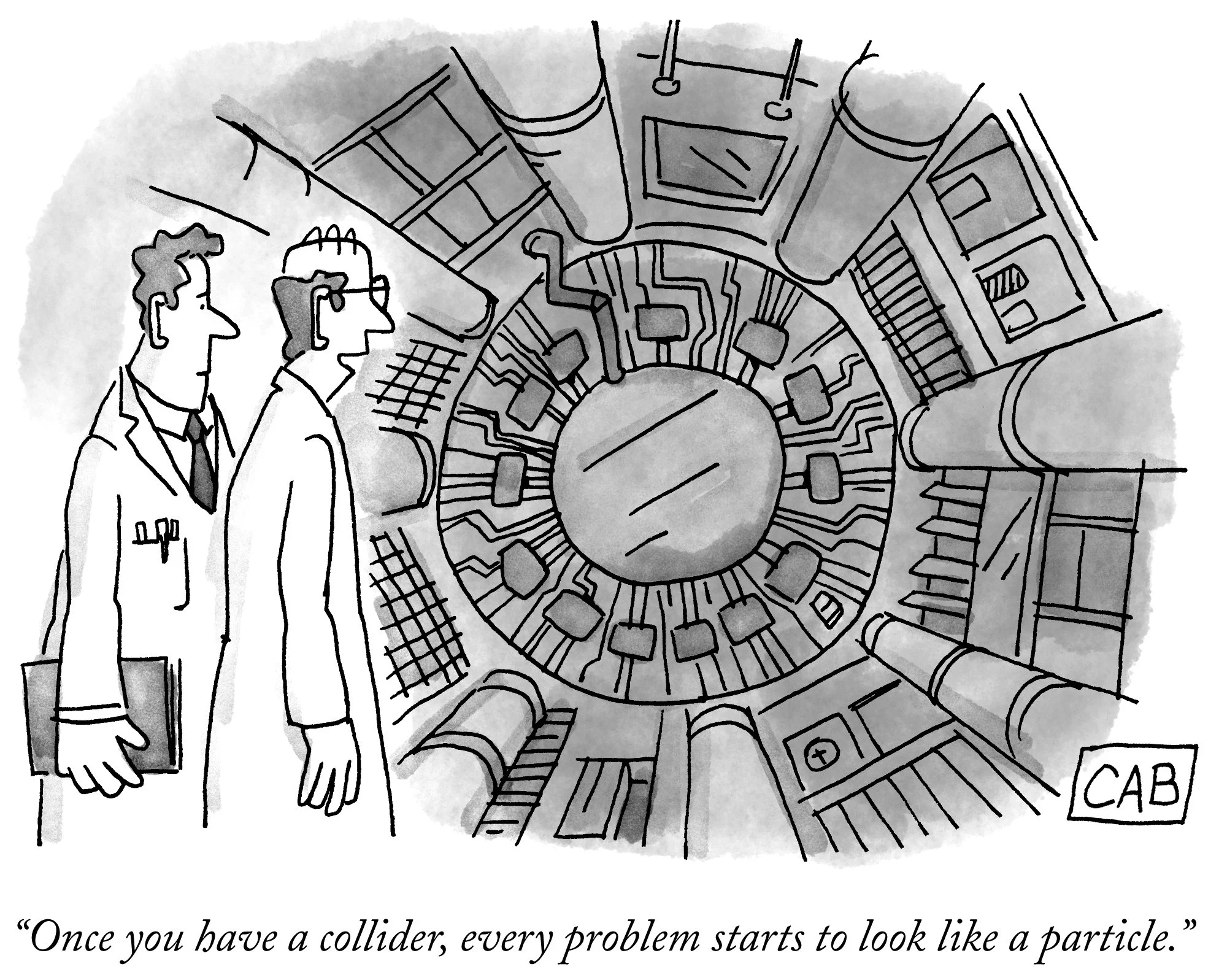
© Adam Cooper / The New Yorker Collection/The Cartoon Bank
Importantly, the current geopolitical climate also strongly favors the AI efficiency story. Advances in technology, including drones and autonomous systems, are transforming military readiness and could foster broader growth.
Don’t think of this as “doomsday investing.” View it as positioning your portfolio for resilience. By leaning into inexpensive companies with fortress balance sheets alongside exposure to transformative technologies like AI, portfolios can better withstand volatility while preparing for recovery and expansion.
In the weeks and months ahead, we can’t predict exact market paths. But we can control our response: stay diversified, avoid panic selling, and recognize that chaos often sows the seeds of opportunity. Focus on quality companies with strong balance sheets.
Just as the humble iron nail transitioned from a scarce luxury to an abundant foundation that built the modern world, AI is moving from expensive novelty to ubiquitous enabler of exponential progress. The short-term chaos of geopolitics and market volatility may feel unsettling, but it does not change this fundamental truth. By maintaining a disciplined focus on attractively valued companies with exceptionally strong balance sheets and thoughtful exposure to emerging technologies, we position ourselves not merely to endure uncertainty—but to participate in the next great wave of abundance. History shows us that the greatest opportunities often emerge precisely when headlines scream the loudest. At MPMG, we will continue to direct our capital and our confidence towards companies that are uniquely positioned to benefit and provide the innovations of tomorrow, while paying reasonable prices.
~MPMG
1 International Data Corporation (IDC), “IDC Predicts AI Solutions & Services will Generate Global Impact of $22.3 Trillion by 2030,” April 1, 2025
2 Drug Target Review (2026): AI in drug discovery predictions; supported by case studies from Insilico Medicine and others showing compression from ~4 years to 13–18 months for preclinical candidate stages.
3 IDC FutureScape: Manufacturing 2026 predictions (reported across multiple IDC analyses and summaries)
4 McKinsey, “Capturing the full value of generative AI in banking” (2023, with ongoing citations in 2024–2025 updates).
5 Impact Express research (2025), as reported in Retail Technology Innovation Hub, CXM Today, and eCommerce News UK
6 Aggregated from developer reports and engineering case studies (e.g., LinkedIn posts and Medium articles detailing AI-assisted debug reductions from ~70% time allocation to significantly lower).
7 World Economic Forum (2026) and related analyses on grid-enhancing technologies; EU studies and industry reports note potential capacity increases of up to 40% on existing lines via AI-driven optimization.
8 From February 24, 2022 to December 31, 2022
9 Alphabet, Amazon, Apple, Meta Platforms, Microsoft, Nvidia, and Tesla.
* Please see enclosed Notes to Performance. Notes to Performance can also be found at https://mpmgllc.com/fact-sheet.
Established in 1995, Minneapolis Portfolio Management Group, LLC actively manages separate accounts for individuals, families, trusts, retirement funds, and institutions. Our proven value-oriented investment philosophy has created long-term wealth for our clients.
Visit our website at: www.MPMGLLC.com
Although the information in this document has been carefully prepared and is believed to be accurate as of the date of publication, it has not been independently verified as to its accuracy or completeness. Information and data included in this document are subject to change based on market and other condition. All prices mentioned above are as of the close of business on the last day of the quarter unless otherwise noted. Market returns discussed in this letter are total returns (including reinvestment of dividends) unless otherwise noted.
The information in this document should not be considered a recommendation to purchase any particular security. There is no assurance that any of the securities noted will be in, or remain in, an account portfolio at the time you receive this document. It should not be assumed that any of the holdings discussed were or will prove to be profitable, or that the investment recommendations or decisions we make in the future will be profitable. The past performance of investments made by MPMG does not guarantee the success of MPMG’s future investments. As with any investment, there can be no assurance that MPMG’s investment objective will be achieved or that an investor will not lose a portion or all of its investment.
Companies mentioned in this document were chosen based on MPMG’s view of the products and/or services offered or provided by the companies in light of current economic and market observations and reported trends. For a complete listing of MPMG’s recommendations over the preceding 12 months, please contact MPMG at (612) 334-2000.
Double-click to edit...